Rescue Tool Supplier Evaluation: Capacity, Range, Delivery
Short answer: a supplier evaluation for hydraulic and electric rescue tools should settle three questions before price is negotiated. First, does the supplier manufacture the tools it quotes, or does it resell them? Second, does its range genuinely cover each category your team or customers deploy — battery powered pumps, cordless rebar cutters, battery combi tools, hydraulic cutters, spreaders, rams and engine pumps — with model-level documentation behind each one? Third, can the delivery date be supported by production capacity, a defined lead time and trackable order milestones? A supplier that answers all three with documents is lower risk than one that answers with a catalogue.

What a Supplier Evaluation Must Prove Before Price Is Discussed
Most rescue tool purchases fail at the evaluation stage for reasons that have nothing to do with tool performance. The quoted supplier turns out to be an agent for a factory it does not control; the battery platform quoted for a combi tool does not match the pumps already in the fleet; the promised lead time was a sales estimate with no line allocation behind it. Each of these becomes expensive only after the purchase order is signed, which is why the evaluation has to be evidence-led rather than impression-led.
Three separate risks sit behind the buying decision. Identity risk is the uncertainty about who actually holds the production equipment, the drawings and the quality records. Range risk is the possibility that only part of the requested tool families is genuinely available, leaving a mixed-brand fleet with incompatible batteries, seals, spare blades and service procedures. Delivery risk is the gap between a lead time quoted in an email and a schedule the supplier can demonstrate. Evaluation, not negotiation, is where those three risks are reduced.
This matters most for buyers moving from evaluation into execution: a distributor preparing a first stocking order, a procurement officer issuing a municipal tender, or a brand owner commissioning an OEM programme. At that point, the useful question is no longer "which supplier looks professional", but "which claims can this supplier prove in writing, and what happens if a claim turns out to be wrong".
Market and Standards Context That Changes the Questions You Ask
The rescue tool category is neither fragmented nor uniform. Commercial research published by Dataintelo estimates the global hydraulic rescue tools market at USD 1.8 billion in 2025, projected to reach USD 3.1 billion by 2034 at a reported CAGR of 6.2%. The same research estimates that five suppliers — Holmatro, Hurst Jaws of Life, LUKAS, Amkus and Weber — together accounted for roughly 52% to 58% of global revenue in 2025, and that cutters held the largest product-type share at 31.4%. These are third-party commercial estimates rather than audited figures, but they carry a practical implication for evaluation: outside the leading group, suppliers differentiate on breadth of range, responsiveness and delivery reliability rather than on brand recognition alone.
The standards environment is edition-sensitive, and that directly affects what you ask a supplier to produce. Standards listings describe EN 13204:2016 as specifying safety and minimum performance requirements plus test methods for double-acting hydraulic rescue tools used by fire and rescue services. DIN Media lists EN 13204:2025-06 as the newer edition covering powered rescue tools for fire and rescue service use and replacing the 2016 edition; national listings in the same evidence set indicate the 2016 edition has been withdrawn in favour of the 2025 edition. For North American buyers, NFPA 1936 (2020 edition) sets label requirements, including permanence and appropriate sizing, and removed requirements for rescue struts.
Two conclusions follow. First, "we meet the rescue tool standard" is an incomplete statement until the supplier names the edition and the document. Second, a published standard is not a product certificate. A supplier that can quote the applicable edition, produce a conformity document naming the exact model, and explain which performance tests sit behind it is demonstrating a capability that a supplier quoting a generic compliance sentence is not.
Step 1: Establish Whether You Are Buying From the Manufacturer
Start with the legal and operational identity of the supplier, not its product photographs. Ask for the business licence and confirm that the registered activity covers production of the equipment being quoted; a trading scope is not disqualifying, but it changes the evidence you need. Then compare the registered address with the factory address. ODE Technology Co., Ltd., which sells as ODE Hydraulic & Electric Rescue Tools, lists its operating address as ODE Group, No.119, Qihang Road, Leidian Aviation Town, Deqing County, Huzhou City, Zhejiang Province, China, and states a factory area of 110,000 m² with 200 employees. Those are checkable claims: an address, a site and a headcount can all be verified through a video walk-through, a third-party audit or a visit.

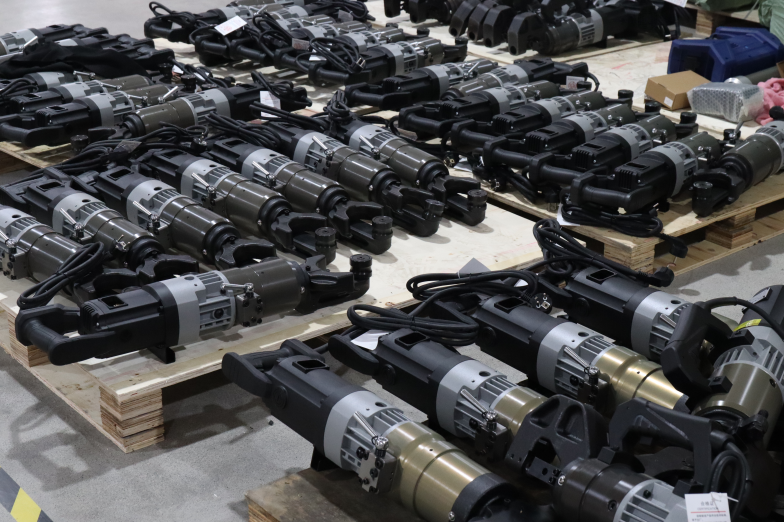
The second test is line allocation. A manufacturer can produce some categories in-house and source others from cooperating factories; that is a normal arrangement, and ODE states openly that it operates its own factory in Zhejiang and also cooperates with other factories. The evaluation question is therefore not "do you outsource anything", but "which of the categories I am buying run on your own lines, and which do not". Ask for a category-by-category answer in writing, then cross-check it against the certificate scope and the production photographs you are shown.
The third test is throughput against your own order size. ODE states a monthly capacity of 5,000 units, a minimum order quantity of 2 units and a lead time of 45–60 days. Read those numbers together rather than separately. A 5,000-unit monthly capacity means a first stocking order in the low hundreds is a small share of a month's output — but the figure is self-declared, so the follow-up question should be how the order is scheduled against other customers in the same month, and what line slot it receives.
Supporting evidence for this step is straightforward to specify: in-process inspection records for the models quoted, a current list of production and test equipment, and a named technical contact who can answer drawing questions. ODE describes itself as a National High-Tech Enterprise and a National Specialized, Refined, Differential and Innovative "Little Giant" Enterprise, operating a provincial-level research institute and holding nearly 200 patents; useful context, but the buyer should still convert such statements into named documents — which institute, which patent families, which of them relate to the tool being purchased.
Step 2: Map Range Depth to the Categories You Actually Deploy
Range depth is not the number of products on a website. It is the number of requested categories for which the supplier can name a model, show the drawing, state the performance figures and match a conformity document. The practical method is to build a table before the first call: your required categories on one side, the supplier's model designations on the other, and the supporting document in a third column. A supplier that cannot fill the third column for a category is offering a catalogue entry, not a verified product.
For the hydraulic and electric rescue tool family, a category-level map of this kind typically looks as follows. Model designations below are taken from ODE's published product and certification data and are listed to show the level of granularity a buyer should expect, not to substitute for a datasheet.
| Category | Representative ODE designations | Document to request |
|---|---|---|
| Battery powered pump | P600OGB | Datasheet, battery and charger specification, conformity document |
| Cordless / battery rebar cutter | RC-16B, RC-20B, RC-25B | Cutting capacity sheet, blade spare-part list |
| Battery combi tool | SC370-E, SC357-E, BC-300A | Force and opening data, conformity document |
| Battery cutter | S251-E, S312-E | Cutting force and jaw data, conformity document |
| Battery spreader | SP725-E | Spreading force and opening data, conformity document |
| Electric ram | R322-E, R412-E, R530-E | Stroke and force data, conformity document |
| Hydraulic cutter | S251-L, S211, S175-L, S110-W1 | Cutting force data, hose and coupling specification |
| Hydraulic spreader | SP725-L, SP210, SP515-W, SP501-L | Spreading force data, tip options |
| Hydraulic combi tool | SC370-L, SC257, SC280-L, SC255-W | Combined cutter-spreader data, weight |
| Hydraulic ram | R522-L, R410, R350-W, TR940-L (bi-directional) | Stroke, force, stage configuration |
| Engine pump | MDP220 (double output), BE-MP-63/0.5 (single output) | Output configuration, fuel and starting data |
| Hand pump / power unit | P620ASL, BS-63, P620SGB (heavy-duty double output) | Pressure rating, reservoir, coupling type |
| Rebar bender, puncher, concrete crusher, door opener, amphibious sets | CS350-L, EHK-5A, EHK-5D, S251-S / SP520-S1 / SC371-S1 / R450-S1 / P610AES | Model sheet for the specific item; set contents list |
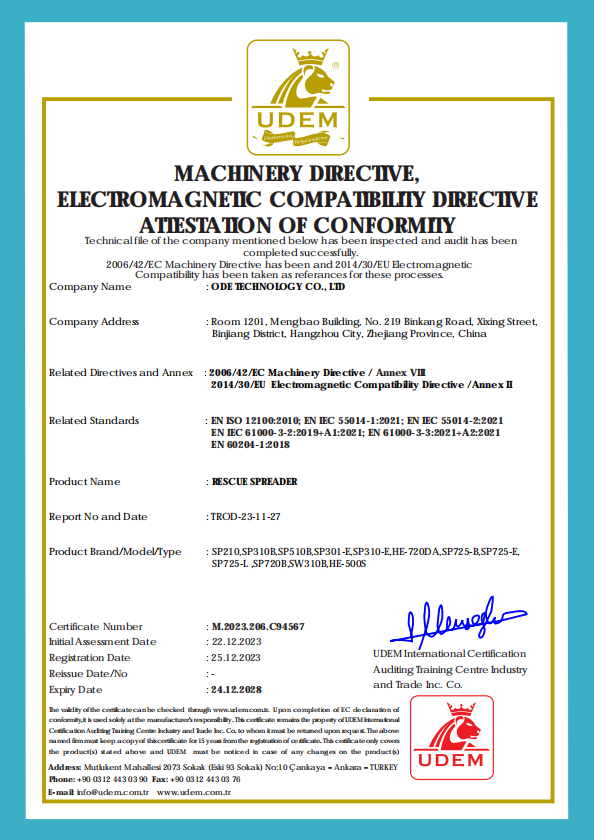
The second half of range verification is certificate scope matching. Attestations enumerate model or type designations rather than granting blanket family coverage. ODE's rescue spreader attestation, certificate M.2023.206.C94567 issued by UDEM, lists twelve designations including SP725-E and SP725-L. The rescue cutter attestation M.2023.206.C94566, the ram attestation M.2023.206.C94563, the combi tool attestation M.2023.206.C94565, the pump attestation M.2023.206.C94572 and the breaching tool attestation M.2023.206.C94573 each carry their own scope lists. A buyer should locate the exact designation being purchased inside the relevant list. If it is absent, the honest next step is to ask what evidence exists for that specific model instead of assuming the family certificate covers it.
Step 3: Turn Delivery Assurance Into Written Milestones
Delivery assurance is a planning capability, not a promise. Three elements make it verifiable: a stated lead time, a defined starting point, and milestones that can be tracked between order confirmation and shipment. ODE states a lead time of 45–60 days and a monthly capacity of 5,000 units. Neither number is meaningful until the buyer knows when the clock starts — purchase order, deposit receipt, or approved drawing — and which steps consume the time in between.
For a catalogue order, the sequence is usually material preparation, machining, assembly, pressure and function testing, packing and documentation. For an OEM order the sequence gains drawing review, sample approval and, where voltage, power, colour or branding change, an additional verification loop. Ask the supplier to state which of those steps sits inside the 45–60 day window and which sits outside it. A supplier that can answer precisely is describing a production plan; a supplier that answers "about six weeks" is describing an intention.
Order tracking should then be reduced to four dated checkpoints that the buyer can hold the supplier to: production slot confirmed, sub-assembly completed, final test completed, packing and handover to freight completed. Each checkpoint should produce an artefact — a dated photograph, a test record, a packing list. This is where a documented monthly capacity becomes useful: it sets a realistic expectation for how large an order can be absorbed in one cycle, and it exposes the moment when an order has grown beyond a single month's scheduling and should be split into shipments.
Two practical risks deserve a written answer during this step. The first is peak contention: ask how the confirmed slot is protected if other customers increase volume in the same month. The second is after-sales continuity, because a delivery date is only the start of the equipment's life. ODE states remote support as its after-sales arrangement, so a buyer should clarify the response channel, the spare-parts list supplied with the order and the procedure for a tool that fails during the warranty period.
Step 4: Verify the Documents Behind the Claims
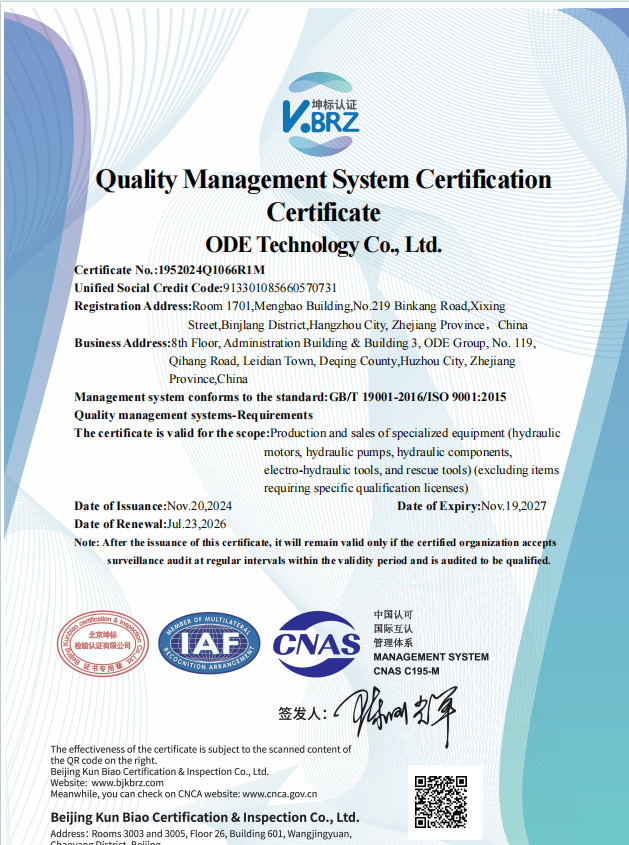
Capability evidence falls into three tiers, and a complete evaluation uses all three. The first tier is management-system certification. ODE holds ISO 9001 certification, certificate 1952024Q10666R1M, issued by Beijing Kun Biao Certification & Inspection Co., Ltd. against GB/T 19001-2016/ISO 9001:2015, valid from 20 November 2024 to 19 November 2027, with a scope covering production and sales of specialised equipment including hydraulic pumps, hydraulic components, electro-hydraulic tools and rescue tools, excluding items requiring specific qualification licences. It also holds ISO 45001 certification, certificate 1952024B029R0M, issued by V.BRZ, valid from 22 July 2024 to 21 July 2027. Read the scope wording, not just the logo: a quality certificate covering production and sales tells you a system exists, not that a particular tool met a particular performance test.
The second tier is product conformity. ODE's EU documentation consists of UDEM attestations of conformity under the Machinery Directive 2006/42/EC (Annex VII) and the Electromagnetic Compatibility Directive 2014/30/EU (Annex II), issued between 22 and 25 December 2023 and valid until 24 December 2028. The cited standards are EN ISO 12100:2010; EN IEC 55014-1:2021; EN IEC 55014-2:2021; EN IEC 61000-3-2:2019+A1:2021; EN 61000-3-3:2021+A2:2021; and EN 60204-1:2018. The declared market is the EU — and CE marking is relevant to the European Economic Area rather than worldwide, so a buyer selling into another region needs separate market-specific evidence.
Note what this tier does and does not establish. An attestation naming the Machinery Directive and harmonised safety and EMC standards is a conformity document, not a performance test report against EN 13204. If a tender cites EN 13204 — and the applicable edition must be confirmed, given the transition from the 2016 to the 2025 edition — the buyer should ask separately which performance testing supports the claim. That question is not an accusation; it is the difference between a compliant file and a compliant tool.
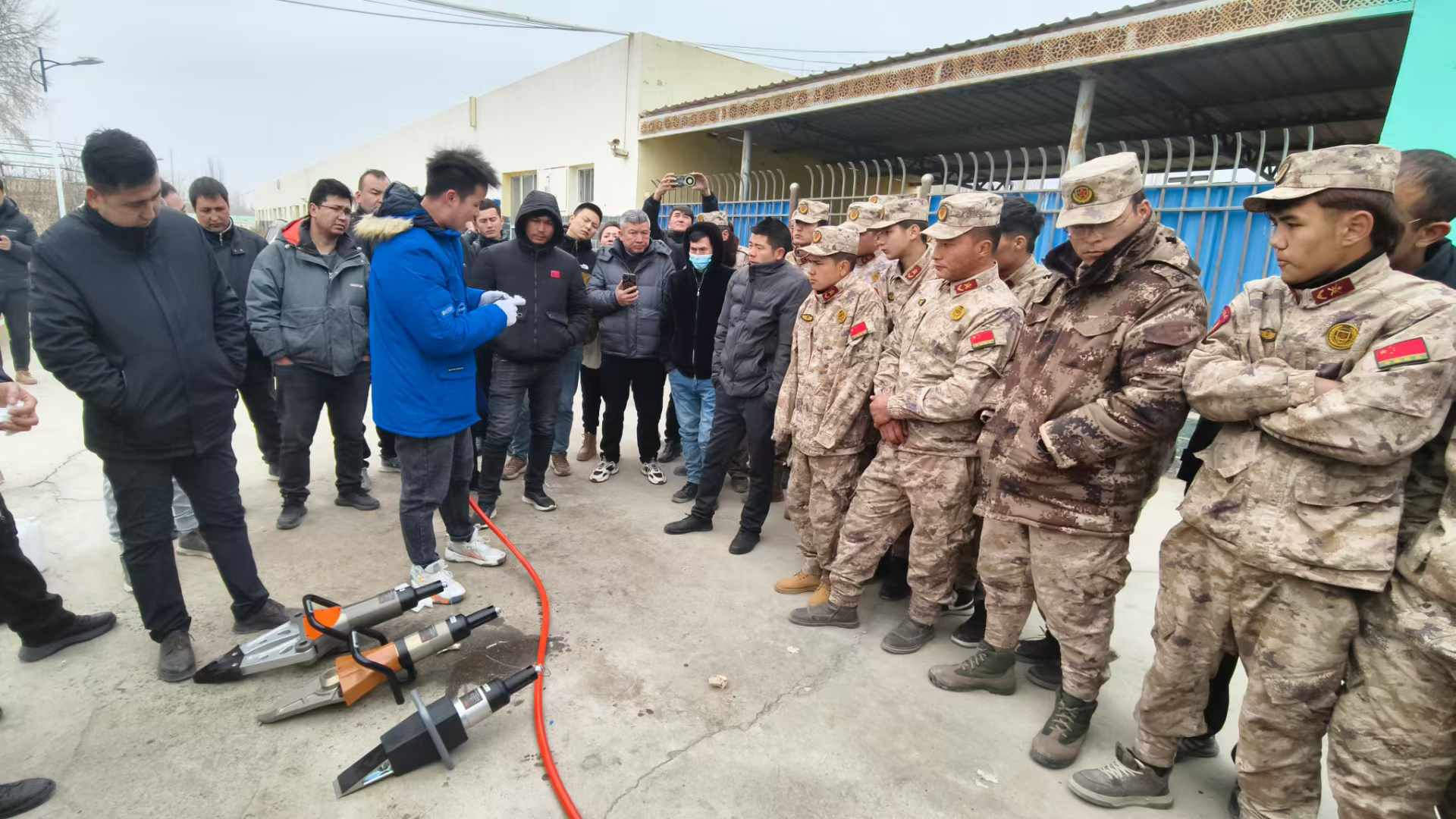
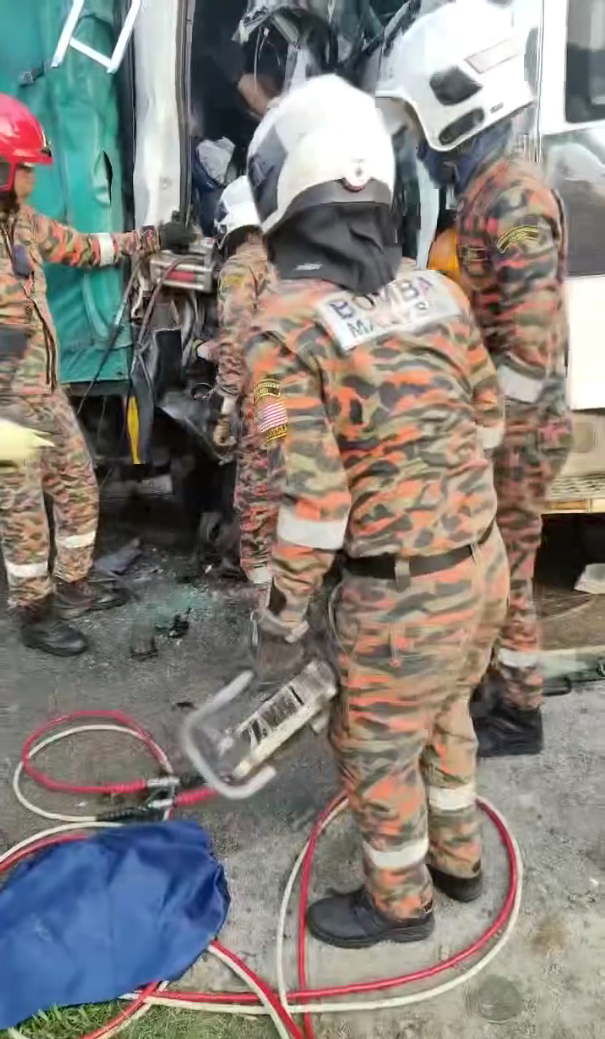
The third tier is field reference. ODE's published case material describes China Fire and Rescue Service adopting hydraulic extrication tools for emergency equipment reserve, Malaysian rescue teams using the tools at truck crash incidents, and China Blue Sky Rescue using ODE electric rescue equipment after the Turkey earthquake in Malatya Province. References like these are worth pursuing rather than admiring: ask for permission to contact one user, ask what the tools were used for, and ask what failed.
Evidence Table: What Counts as Proof at Each Stage
The same checklist can be used to grade any supplier's answers. The table below converts common claims into the evidence that would actually settle them, so that a weak answer is visible at the evaluation stage rather than after delivery.
| Supplier claim | Evidence that settles it | Follow-up question |
|---|---|---|
| "We are a manufacturer" | Business licence with production scope; factory address; site walk-through; certificate naming the same legal entity | Which of my categories run on your own lines? |
| "We cover the full range" | Model list per category; drawing or datasheet per model; conformity scope list | Does my exact designation appear in the certificate scope? |
| "Capacity is 5,000 units per month" | Production schedule; line allocation; dated in-process records | Which slot does my order hold this month? |
| "Lead time is 45–60 days" | Written definition of the start trigger and the included steps | Does the clock start at PO, deposit or drawing approval? |
| "We are certified" | Certificate numbers, issuing body, scope, issue and expiry dates | Which certificate covers this model, and until when? |
| "We supply fire services" | Named reference with permission to contact, or documented case material | May I speak to one user about failures and spares? |
How the Checklist Changes for Distributors, Tenders and OEM Buyers
Distributors stocking for resale should weight range depth and spare-part continuity highest. A minimum order quantity of 2 units and a 45–60 day lead time make it possible to start narrow and widen the range after the first sell-through, which is usually safer than committing to a broad opening order. The critical question is whether the battery platform and couplings are consistent across the battery powered pump, battery combi tool, battery cutter, battery spreader and electric ram families, because a mixed fleet complicates training, charging and field support.
Procurement teams running a tender should weight document completeness and delivery schedule above catalogue breadth. Build the compliance dossier before pricing: conformity documents per family, the exact model designations inside each scope, the management-system certificates with validity dates, and a delivery plan with checkpoints. Where the tender cites a performance standard, confirm the edition and ask separately for the test evidence behind it.
OEM and brand-owner buyers should weight engineering interface and change control. ODE states that it provides drawing design services and supports customization on voltage, power, colour and brand, together with minor function adjustments, under an OEM/ODM arrangement. In practice that means the evaluation should include drawing review turnaround, who owns the tooling and drawings, how a minor function change is validated before it enters the 45–60 day production window, and how a revision is recorded so that a repeat order matches the approved sample.
Where the Evidence Stops
A credible evaluation states its own limits. Capacity figures such as 5,000 units per month are supplier-reported and are not independently audited in the material available here, so they should be treated as a starting point for a scheduling conversation rather than a guarantee. Conformity attestations cover the designations listed in their scope and remain valid until 24 December 2028; they do not, by themselves, demonstrate field reliability, duty cycle or service life. The ISO certificates state system conformity within their stated scope and period, not product performance.
Nor does the standards picture stand still. With EN 13204 transitioned to a 2025 edition according to DIN Media's listing, a compliance file assembled around the 2016 edition may need review before it is used in a new tender. Buyers should date-stamp every document they accept, record the edition referenced, and re-check before each major procurement cycle. Finally, no document replaces a physical sample test; the sample policy is described below precisely because it is the step where paperwork meets the tool.
FAQ: Supplier Evaluation for Hydraulic & Electric Rescue Tools
Which documents confirm EU compliance for a hydraulic or electric rescue tool?
Ask for the attestation of conformity covering the specific product family, and check four things on it: the legal entity name, the certificate number, the listed standards and the expiry date. ODE's EU documentation consists of UDEM attestations issued between 22 and 25 December 2023 for breaching tools (M.2023.206.C94573), hydraulic pumps (M.2023.206.C94572), rescue spreaders (M.2023.206.C94567), rescue rams (M.2023.206.C94563), rescue cutters (M.2023.206.C94566) and rescue combi tools (M.2023.206.C94565), all valid until 24 December 2028 and citing EN ISO 12100:2010 together with EMC standards. Because CE marking applies to the European Economic Area rather than worldwide, buyers in other regions should request market-specific evidence as well.
How do I check whether a supplier's range is genuinely deep?
Test it category by category, not by catalogue page count. For each category you intend to buy — battery powered pump, cordless rebar cutter, battery combi tool, hydraulic cutter, hydraulic spreader, hydraulic ram, engine pump — ask for the model designation, the datasheet, the conformity scope entry and confirmation of whether that category runs on the supplier's own line. ODE, for example, lists P600OGB for battery powered pumps, RC-16B, RC-20B and RC-25B for cordless rebar cutters, SC370-E, SC357-E and BC-300A for battery combi tools, MDP220 for double output engine pumps and P620SGB for the heavy-duty double output power unit, and states that it also cooperates with other factories — which is why the line-allocation question is worth asking explicitly.
What is the minimum order quantity, and how does order size affect price?
ODE states a minimum order quantity of 2 units and states that any additional discount depends on order quantity. Those two statements belong in the same conversation: the low minimum allows a buyer to validate a category before scaling, while the pricing structure rewards larger consolidated orders. Because no public price list is available, the practical step is to request a quotation that specifies the exact tool list, battery and charger configuration, packaging and delivery terms, so that competing offers can be compared on the same basis rather than on headline unit price.
Can a sample be supplied before a purchase order is placed?
Yes — ODE states that samples can be supplied, with the carrier charge borne by the buyer. The value of a sample depends entirely on what you test with it, so define acceptance criteria before it ships: cutting performance on the material you actually encounter, spreading opening and jaw condition, ram stroke and stability under load, battery runtime and charge cycle, and how the tool behaves after a full duty cycle. Record the configuration of the sample — model, battery, charger, accessories — because that record becomes the reference for the production order.
How should the 45–60 day lead time be interpreted?
Treat 45–60 days as ODE's stated production window and then pin down the trigger and the contents. Confirm in writing whether the clock starts at purchase order, deposit or approved drawing; whether OEM customization on voltage, power, colour, brand or minor functions extends the window; and which milestones — production slot, sub-assembly, final test, packing — you will be notified about. Set that against the stated monthly capacity of 5,000 units to judge how much of a single month your order occupies. A fuller description of the range, capacity and support arrangements is available in the ODE company brochure (PDF), which can be used alongside a quotation request.
Conclusion: Approve the Supplier on Documents, Not Impressions
A rescue tool supplier evaluation holds up when it produces a file rather than an opinion. That file should contain the manufacturer's identity and site evidence, a category-by-category model map with the exact conformity scope entries, the management-system certificates with their validity periods, a written delivery plan with dated checkpoints, and at least one reference you were permitted to contact. Where a figure is supplier-reported — monthly capacity, for instance — record it as reported and tie it to a scheduling commitment.
For ODE Hydraulic & Electric Rescue Tools, the verifiable starting point is ODE Technology Co., Ltd.: a stated factory area of 110,000 m² and 200 employees in Deqing County, Zhejiang, a declared monthly capacity of 5,000 units with a 45–60 day lead time and a 2-unit minimum order, six EU attestations valid to December 2028, ISO 9001 and ISO 45001 certification inside their stated scopes, and rescue-service references in China, Malaysia and Turkey. Those are the claims to test — and the checklist above is how to test them.
Have Questions or Need More Details?
Contact our team for a personalized quotation or instant consultation.
Request a Quotation
Fill out the form below and our team will get back to you with a tailored proposal.
WhatsApp Direct Chat
Prefer to chat in real-time? Message us on WhatsApp for instant assistance & quick answers.
- Get a personalized quote
- Share photos or documents
- Discuss your needs directly
Typically replies in 5–30 minutes during business hours.