Hydraulic & Electric Rescue Tools: Flood Team Set Checklist
Hydraulic & Electric Rescue Tools for Flood Teams: Amphibious Set Checklist
A flood team does not need a larger tool set at the water line; it needs a set whose tools can be carried, connected and used in the order the work actually happens. For amphibious rescue work that order is access, cutting, lifting and stabilization, supported by five core roles: a spreader, a combi tool, a cutter, a ram and a pump. The Rescue Backpack Door opener starts the entry, and a battery powered pump or a cordless rebar cutter replaces the hose run where the work point is too far, too confined or too wet for a pump-and-hose pair.
This article maps those roles to flood and waterfront scenarios and converts the mapping into a configuration checklist. It is a checklist, not a performance claim. Every figure quoted below is the documented value for the named Ode model, stated with the material and condition under which ODE publishes it, and items that appear in the configuration without published specifications are labelled as items to confirm rather than described as rated.
What “amphibious” covers in the ODE rescue tool family
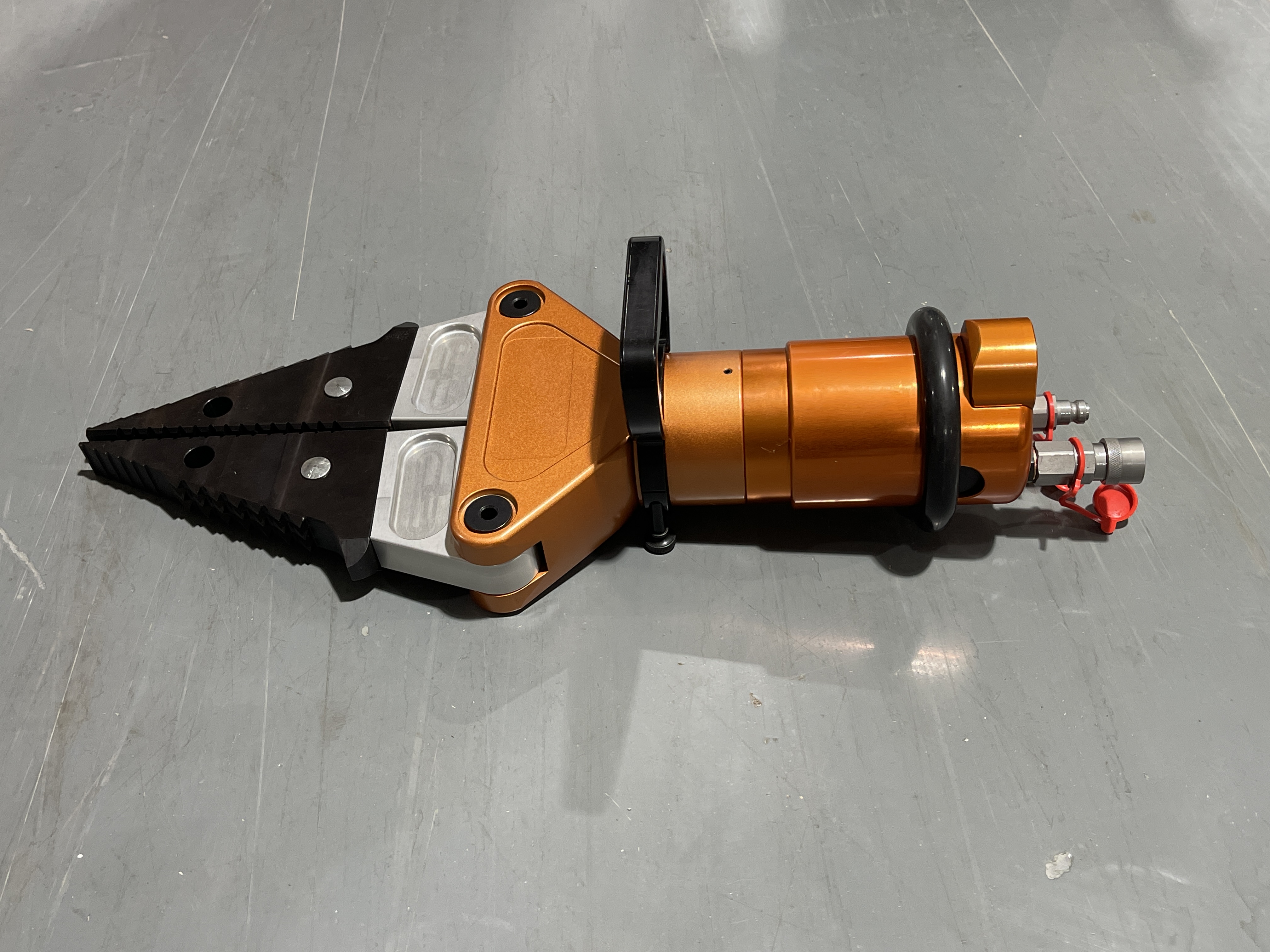
In the ODE range, amphibious is a model-level designation, not a property of the entire catalogue. The range description states that amphibious versions support both land and underwater rescue, and the SP520-S1 is listed as an amphibious rescue tool set spreader. The hydraulic cutter and spreader, the hydraulic combi tool, the rams and the pumps must each be confirmed item by item before a buyer treats them as water-rated.
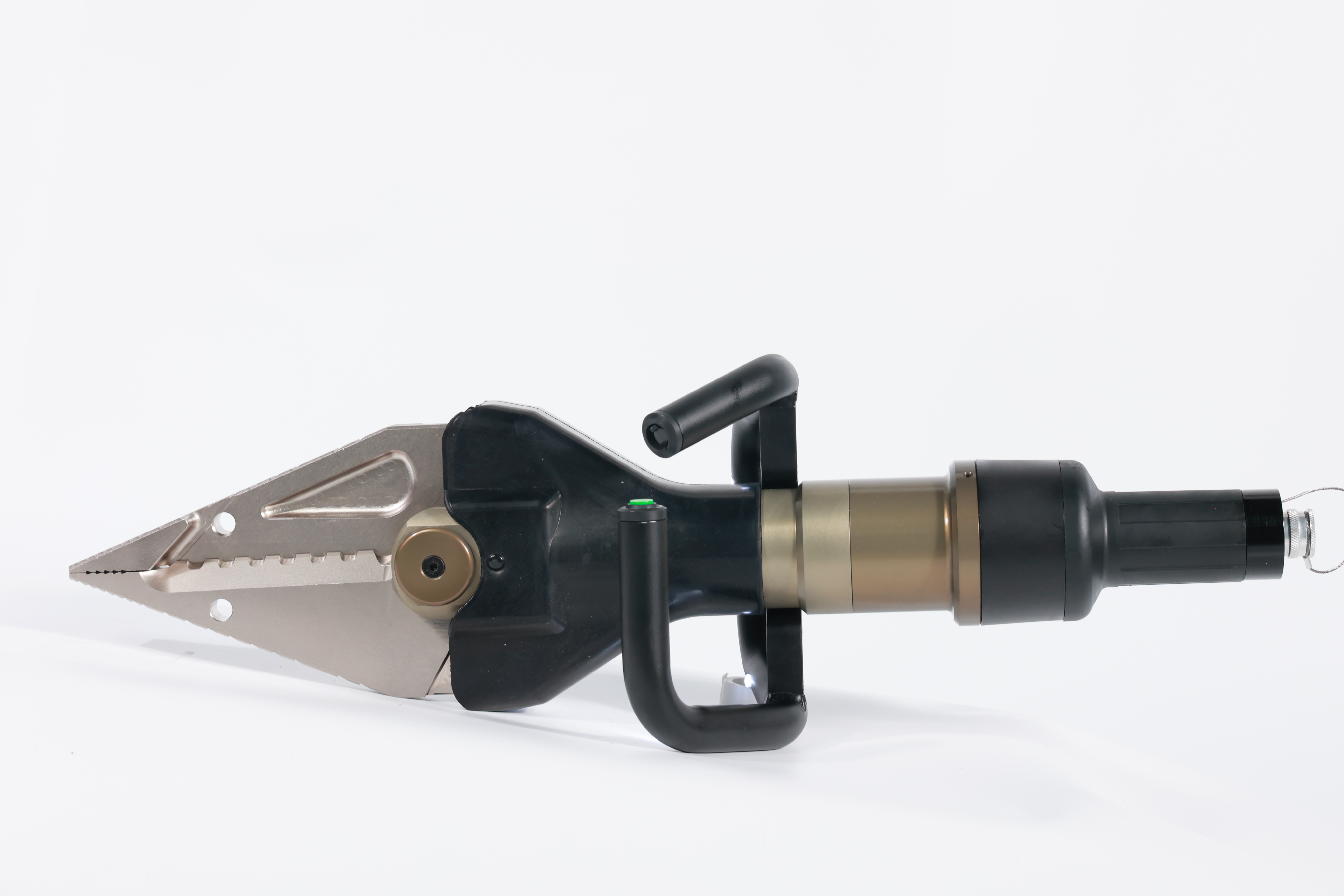
The SP520-S1 is documented at a rated working pressure of ≥72 MPa, spreading force of 36–100 kN, expansion distance of ≥508 mm, pulling distance of ≥430 mm and maximum pulling force of 33 kN, with a weight of 11.7 kg. Its supplied features include spreading, tearing, squeezing and pulling functions, 360° ergonomic handles with built-in LED lighting, a shark-tooth anti-slip spreading head, a concrete breaking head and a steel plate tearing demolition head, a male-female snap fastener interface and an anti-slip switch. A wireless remote unit on the remote-control variant operates the tool and switches between two circuit modes with a range of up to 70 m.
The practical consequence for a flood team is a two-zone configuration. The water-line zone is built only from models that carry the amphibious designation in writing, and the dry staging zone can use the standard hydraulic set — the S211 cutter, SP210 spreader, SC257 combi tool and R410 ram, rated at 72 MPa with documented cutting and spreading figures — or its battery equivalent. Keeping the two zones explicit prevents a team from assuming that a tool bought for crash rescue is automatically cleared for submerged use.
Why a normal rescue set needs re-planning at the water line
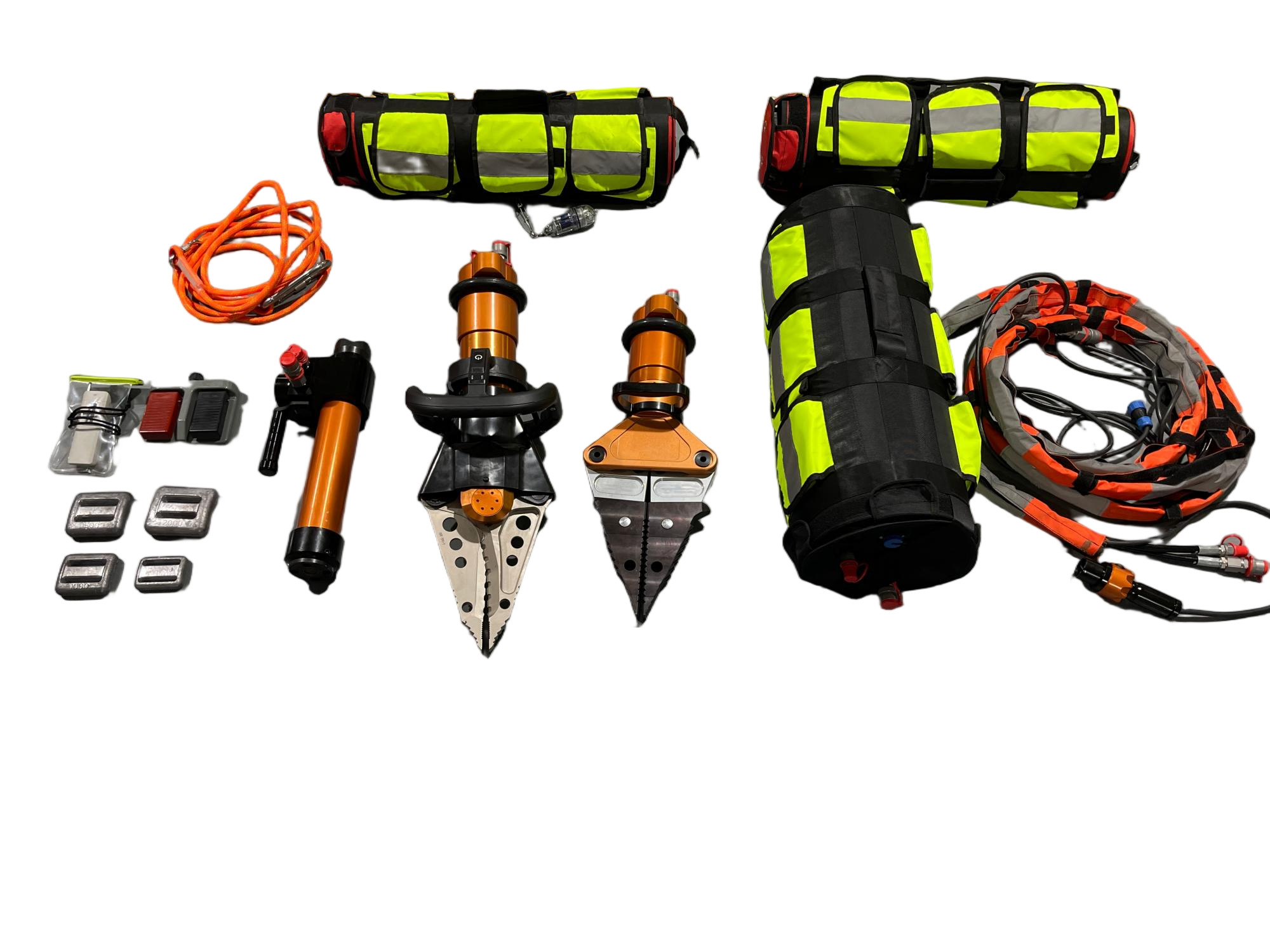
Flood work changes the logistics of a rescue set more than it changes the tools themselves. Four conditions force the re-plan.
Hose geometry. A hydraulic tool is only as useful as the distance between it and its pump. In a flooded stairwell, a submerged car park or a culvert headwall, that distance is often vertical, obstructed or covered in moving water. ODE describes its electric tools as an integrated hose-free design that allows single-person operation and shortens pre-rescue preparation time; on a flood scene that property is the difference between deploying at the water line and deploying at the top of the bank.
Pump placement. An engine-driven pump needs dry, level ground and produces exhaust. Inside a flooded basement, a service tunnel or a closed pump chamber, the battery powered pump P600OGB is documented with low noise and zero exhaust emission, which makes it the more workable power source in enclosed, water-adjacent space. That is a siting characteristic, not a statement about which pump is more capable.
Wet hands and silt. Gloved, wet hands struggle with small connectors. The mechanical threaded rotary joint on the P600OGB is documented as securing easily even when wearing gloves, and the flat-seal flat-axis single connector used across several ODE tools allows connection and disconnection under pressure and is easy to clean — useful where silt and grit contaminate every coupling.
Battery discipline. Battery tools carry a seven-level LED indicator and a low-power alarm below 20% capacity, and the battery combi tool SC370-E and battery spreader SP725-E each ship with two batteries, one charger and one belt as standard. A flood deployment should plan battery rotation the same way it plans rope or fuel.
The deployment sequence: access, cutting, lifting, stabilization
The four stages below are a planning order, not a rigid script. Flood scenes frequently return a team to the access stage after a lift, and the sequence should be re-entered rather than forced.
Stage 1 — Access: open, then widen
Entry comes first. The Rescue Backpack Door opener is positioned as the initial-entry item for doors, shutters and service hatches, carried by the lead rescuer so that the first opening does not wait for a pump to be set. Once an opening exists, the hydraulic combi tool SC280-L or the amphibious spreader SP520-S1 widens it. The SC280-L is documented at ≥72 MPa with maximum cutting force ≥32 kN, cutting capacity ≥φ25 mm Q235A round steel, minimum spreading force ≥14.4 kN, maximum spreading distance ≥280 mm, pulling distance ≥205 mm and a weight of 7.8 kg — light enough to be carried through a flooded corridor by one rescuer.
Head choice matters more than force at this stage. Wedge-shaped flat spreading heads fit narrow gaps; forcible entry heads target security doors and rolling shutters; the shark-tooth anti-slip structure is designed to hold on inclined or smooth surfaces. Modular quick-change heads let the same body move from widening to tearing without a second tool being carried in.
Stage 2 — Cutting: match the material, not the habit
Cutting should be the shortest stage in flood work, because every cut is made in wet conditions with limited footing. The hydraulic cutter S251-L is documented at 72 MPa with maximum cutting force 940 kN, cutting diameter Ø40 mm Q235 round steel, opening distance 250 mm and a weight of 12.5 kg. The SC280-L combi tool covers smaller sections with its ≥φ25 mm Q235A round-steel capacity, which is often enough for handrails, mesh and light structural steel.
Two cordless options change the geometry of this stage. A cordless rebar cutter suits rebar grids, debris racks and mesh where the cut point is beyond the reach of a hose, and the battery rescue cutter S251-E belongs to the hose-free electric set alongside the battery combi tool SC370-E, battery spreader SP725-E and 2-stage electric ram R322-E. When specifying cordless cutting, confirm which battery platform and charger each item uses rather than assuming the 28 V packs are interchangeable across every model.
Stage 3 — Lifting: push, do not pull
Lifting in flood work usually means creating clearance under a displaced slab, a vehicle roof or a collapsed wall section so that a casualty or a rescuer can pass. The SP520-S1 covers this with its 36–100 kN spreading force and ≥508 mm expansion; the larger hydraulic spreader SP725-L is documented at 38–65 kN spreading force, 740 mm maximum spreading distance, 640 mm pulling distance, 52 kN pulling force and 16.7 kg. For straight-line lifting, the hydraulic ram R350-W is documented at ≥72 MPa with 100 kN lifting force, 400 mm closed length, 570 mm extended length, 170 mm maximum lifting stroke and 7.4 kg, while the 2-stage ram R522-L extends further, with a first-stage lift to 935 mm at 275 kN and a second-stage lift to 1285 mm at 140 kN.
Choose the ram by the gap you must hold open, not by the force figure alone: a short ram that fits the access is more useful than a longer ram that cannot be inserted.
Stage 4 — Stabilization: hold before anyone enters
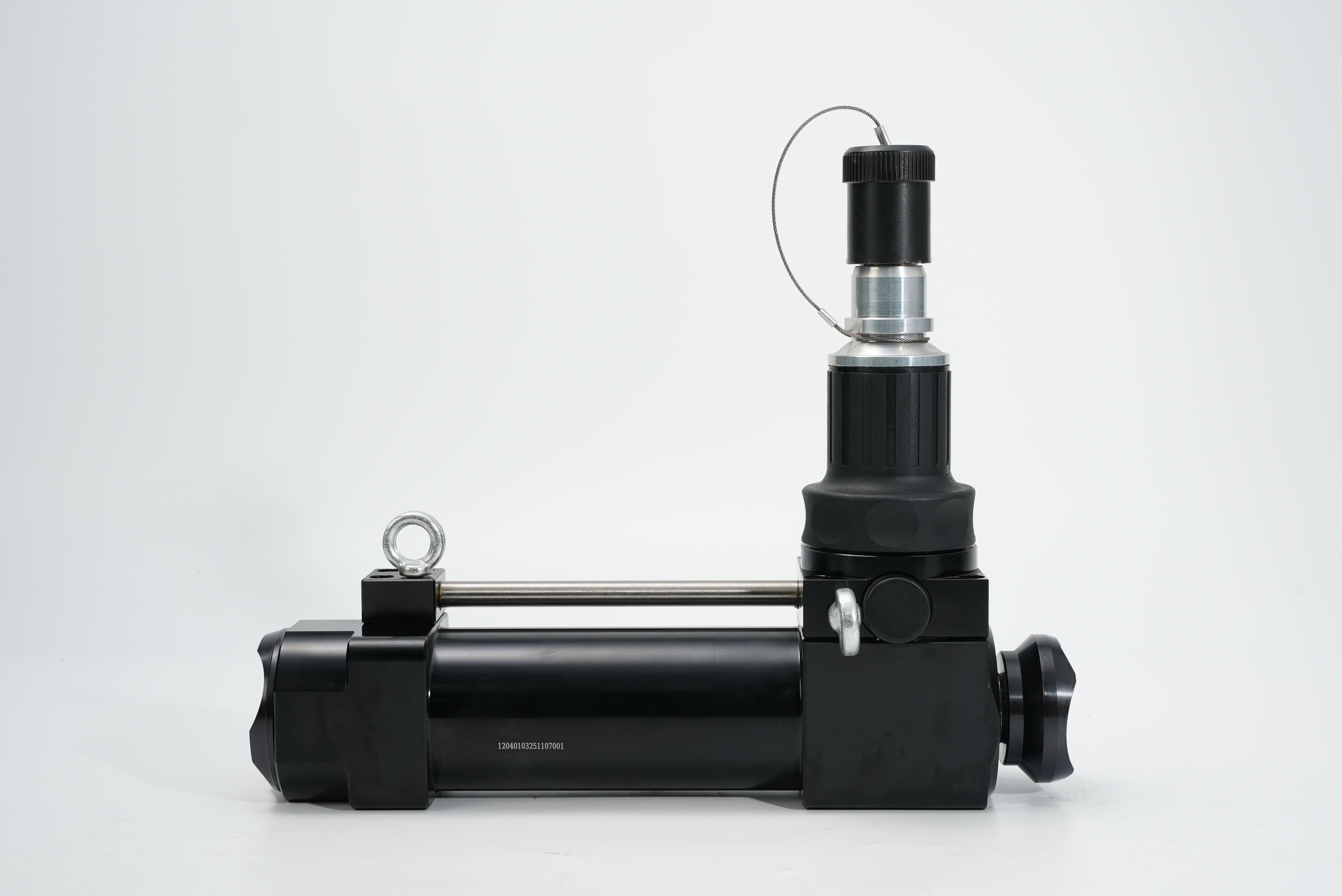
Stabilization is the stage most often skipped by teams transferring habits from vehicle rescue. A lifted load in saturated ground can settle again, and nobody should pass under it until the load is held. ODE tools carry built-in bi-directional hydraulic locks with a self-locking function that hold the tool at any position and prevent unexpected retraction, and the rams are supplied with a quick-change anti-slip pushing head that rotates freely through 360°, with a shark-tooth structure for inclined or smooth surfaces.
Where the geometry does not suit a ram, a wedge jack is positioned as an optional supplement: it is inserted into a gap and expanded to take the load, and it is used in combination with, not instead of, a monitored ram. After stabilization, the team re-checks the load, the footing and the water level before the next entry.
Power and hose configuration
Pressure is the easy part: the hydraulic tools described in this guide are documented at 72 MPa, and the battery tools at 720 bar, which is the same value expressed in different units. Connectors and power sources are where configurations go wrong.
Dual-output engine or motor pump. The MDP220 double-output engine pump is documented at ≥72 MPa with a 2.2 kW four-stroke engine, rated speed ≥3600 r/min, high-pressure flow 0.84 / 1.65 L/min, low-pressure flow 3.5 / 6.95 L/min, hydraulic oil tank ≥4.5 L and a weight of ≤23 kg. The heavy-duty double-output power unit P620SGB is documented at 720 bar × 2, 3600 ± 150 r/min, 2.2 kW, high/low pressure flow 2 × 0.66 L/min and 2 × 2.0 L/min, 2.2 L oil tank, 1.2 L gasoline tank, 24.6 kg, and ships with two sets of 5-metre hoses. Two circuits mean two tools can be staged at one position; on a flood site that usually means one tool cutting and one tool holding.
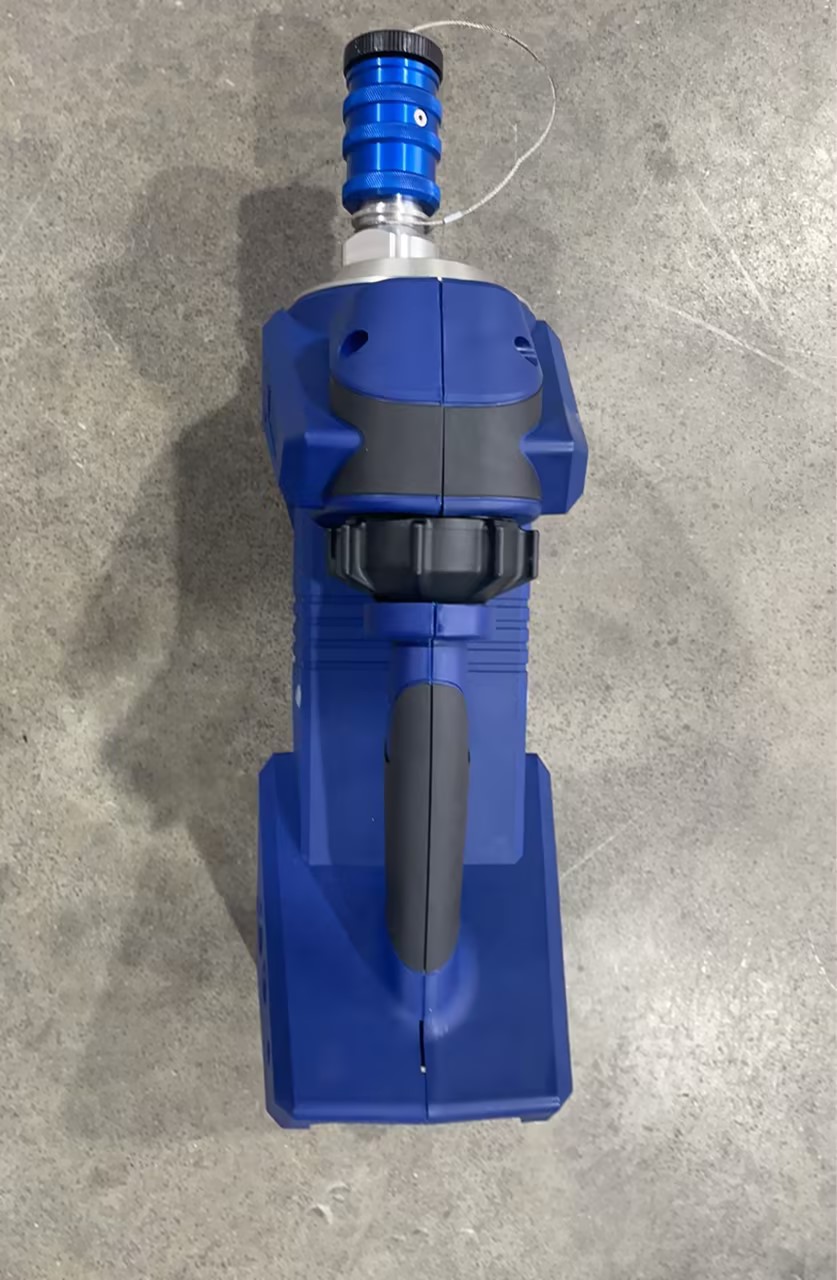
Battery powered pump. The P600OGB is documented at 28 V, 5.0 Ah, 72 MPa rated operating pressure, 1.89 L/min low-pressure and 0.48 L/min high-pressure output, 1.5 L oil tank, 480 × 182 × 257 mm and ≤8.9 kg excluding battery. Its double-hose single connector allows visual inspection of hose status and hot connection or disconnection, and the unit carries built-in LED lighting. Match the pump’s documented flow to the tool being driven, and treat the battery pump as the hose-free alternative rather than a universal substitute for a dual-output pump.
Manual pump. The BS-63 manual pump is documented at 72 MPa, 2.4 L oil volume, 50–100 bar low-pressure output, 2.57 ml/times high-pressure flow, 17 ml/times low-pressure flow, 264 N maximum handle force and 7.8 kg. It is positioned here as an optional supplement for a single low-speed operation where no powered pump is available.
Connector discipline. ODE tools use three connection approaches: male-female snap fasteners, flat-seal flat-axis single connectors that allow connection and disconnection under pressure and are easy to clean, and threaded single connectors compatible with different power pumps. Pick one standard for the set and one adapter policy for legacy stock, and write both into the configuration.
Scenario matrix for flood and waterfront tasks
The table maps typical flood assignments to the sequence stage they stress and to the tools that lead each stage.
| Scenario | Sequence emphasis | Leading tools | Power and cordless note |
|---|---|---|---|
| Submerged stairwell or basement entry | Access, then stabilize | Rescue Backpack Door opener, combi tool SC280-L, ram R350-W | Battery pump staged at the stair head to avoid a hose run down the well |
| Vehicle resting in floodwater | Access, cut, lift, stabilize | Cutter S251-L, spreader SP520-S1, ram | Dual-output pump on dry ground, or battery tools if the bank is unstable |
| Displaced waterfront wall or retaining section | Lift, then hold | Spreader SP725-L, 2-stage ram R522-L | Two-circuit pump keeps one tool cutting while one holds |
| Rebar grid or debris rack at a culvert or screen | Cut, then clear | Cutter, combi tool, cordless rebar cutter | Cordless cutting where the hose cannot follow the debris line |
| Pump station, gate or roller shutter entry | Access, then widen | Door opener, spreader with forcible entry head | Battery pump for enclosed spaces with exhaust restrictions |
Configuration checklist for a flood team
Build the set in three tiers so that purchases remain defensible in a budget review and every item has a stated job.
- Amphibious spreader SP520-S1 — spreading, tearing, squeezing and pulling at the water line
- Hydraulic combi tool SC280-L — access, light cutting, pulling
- Hydraulic cutter S251-L — structural steel, rebar, plate and pipe cutting
- Ram R350-W for short gaps, or 2-stage ram R522-L where a longer hold is needed
- Battery powered pump P600OGB for hose-free work, plus a dual-output pump (MDP220 or P620SGB) for sustained two-circuit tasks
- Attachment set: shark-tooth anti-slip spreading head, wedge-shaped flat spreading head, forcible entry head, tearing and slitting head, 360° anti-slip pushing head
- Consumables: two batteries and one charger per battery tool, carrying straps, military-grade rolling cases, spare hoses and couplings
- Battery combi tool SC370-E — 28 V, 5 Ah, 720 bar, cutting Φ38 mm Q235 round steel and 20 mm Q235 plate, spreading force 45–145 kN, spreading distance 390 mm, 18.5 kg, listed as EN 13204 approved
- Battery spreader SP725-E — 28 V, 5.0 Ah, 720 bar, 38–65 kN spreading force, 740 mm spreading distance, 22.6 kg, listed as EN 13204 approved
- Battery rescue cutter S251-E and 2-stage electric ram R322-E to complete a fully hose-free set
- Cordless rebar cutter where rebar is the blocking material and the cut point is beyond hose reach — confirm model, capacity and battery platform with the supplier
- Manual pump BS-63 — 72 MPa, 7.8 kg, for a single low-speed operation without a powered pump
- Mini cutter — tight-space cutting where a full cutter body will not enter; confirm model and capacity before ordering
- Wedge jack — secondary load-holding in geometries that do not suit a ram; confirm model and rating before ordering
Compatibility and verification checks before ordering
Five checks turn the checklist into a purchase that survives a technical review.
1. Standard edition and model-level conformity. EN 13204:2016 specified safety and performance requirements for double-acting hydraulic rescue tools. DIN Media lists EN 13204:2025-06, titled “Powered rescue tools for fire and rescue service use — Safety and performance requirements”, as replacing the 2016 edition and earlier related standards, and Standards Norway lists the 2016 edition as withdrawn with the 2025 edition published. Because the 2025 title extends beyond double-acting hydraulic tools, ask the supplier which edition and which clauses apply to each item, and request the declaration of conformity and test reports rather than a certificate reference alone. For North America, NFPA 1936 (2020 edition) addresses rescue-tool requirements and requires permanent, appropriately sized labels. ODE lists EN 13204 approval against specific models, including the SC370-E and SP725-E, so the approval should be read as model-specific.
2. Amphibious scope in writing. Ask which items in the quotation carry the amphibious designation, and ask what documentation accompanies that designation. The range description states that amphibious versions support both land and underwater rescue; it does not state that every tool shares that rating.
3. Connector, pump and battery matching. Confirm one connector standard across the set, confirm each pump’s documented flow and pressure against each tool, and confirm battery and charger compatibility item by item. These three checks prevent a set that is complete on paper but cannot be connected on site.
4. Reference programmes. The reference applications ODE supplies cover vehicle-crash extrication by a Malaysian civil rescue team, structural-collapse and earthquake response by China Blue Sky Rescue in Malatya Province, Turkey, and an emergency equipment reserve for the China Fire and Rescue Service. None of these is a flood deployment, so request flood or waterfront references, or plan a supervised trial, before treating a configuration as validated for submerged work.
5. Commercial and support terms. ODE states OEM/ODM capability with drawing design support and customization of voltage, power, color, brand and minor function adjustments, a monthly capacity of 5,000 units, a minimum order of 2 units, a lead time of 45–60 days and remote after-sales support. Confirm these terms against the exact configuration, because a customized build and a catalogue build rarely share a schedule.
For company background, ODE Technology Co., Ltd. is a China-based manufacturer of hydraulic and electric rescue tools whose portfolio includes hydraulic cutters and spreaders, combi tools, rams, rebar cutters and benders, and electric tools built on a 28 V battery system. The company reports a 110,000 m² factory and 200 employees; verify factory ownership, quality-system records and product-specific certification directly during supplier qualification rather than relying on a catalogue statement.
Frequently asked questions
Which standard edition should a flood-team configuration be checked against?
Check the edition stated on the supplier’s current declaration of conformity. EN 13204:2016 covered double-acting hydraulic rescue tools; DIN Media lists EN 13204:2025-06 as replacing the 2016 edition and earlier related standards, and Standards Norway lists the 2016 edition as withdrawn with the 2025 edition published. Because the 2025 edition is titled for powered rescue tools rather than only double-acting hydraulic tools, the applicable clauses must be confirmed per item. In North America, NFPA 1936 (2020 edition) applies and requires permanent, appropriately sized labels on rescue tools. Treat any certificate reference as model-specific and request the supporting test report.
What does “amphibious” actually cover in this tool set?
The designation is model-level. ODE states that amphibious versions support both land and underwater rescue, and the SP520-S1 spreader is listed as an amphibious model with a rated working pressure of ≥72 MPa, 36–100 kN spreading force, ≥508 mm expansion distance and 11.7 kg weight. The hydraulic cutter and spreader, combi tool, rams and pumps should each be confirmed in writing before submerged use. A flood configuration therefore separates a water-line core of amphibious-designated models from standard hydraulic tools kept on dry staging.
Can one pump run the whole set, and what changes with a battery pump?
The hydraulic tools described here share a documented 72 MPa rating, but connectors and flow differ. Dual-output units such as the P620SGB provide two circuits at 720 bar with two sets of 5-metre hoses, while the P600OGB battery pump delivers 72 MPa with 1.89 L/min low-pressure and 0.48 L/min high-pressure output and a 1.5 L oil tank. Each tool’s flow requirement should be matched to the chosen pump. Connectors also vary — male-female snap fasteners, flat-seal flat-axis single connectors rated for connection under pressure, and threaded single connectors — so one standard should be fixed for the set and an adapter policy written for existing stock.
What drives the budget of a flood-team configuration?
Budget is driven by configuration decisions rather than by a single headline item: how many of the five roles are purchased, whether power comes from a dual-output pump, a battery pump or both, how many batteries and chargers are needed for rotation, which connector standard is specified, how many quick-change heads and attachments are included, whether cases are military-grade rolling cases, and how much OEM/ODM customization is requested. Spares — hoses, couplings, batteries — should be costed with the first order. ODE states a minimum order of 2 units and a lead time of 45–60 days, so ask for an itemized quotation that separates tools, power sources, attachments and spares.
Can I obtain a sample, and how long does delivery take?
Samples can be supplied, with the carrier charge on the buyer’s side, and the stated minimum order quantity is 2 units. Standard lead time is 45–60 days against a monthly capacity of 5,000 units, with remote after-sales support. For a flood programme the practical next step is to send the intended task list — access, cutting, lifting and stabilization points — together with the water conditions, so that the configuration, connector standard and power-source mix can be reviewed before a sample or quotation is issued. The ODE company and product brochure provides the full model list for that review.
Conclusion
An amphibious set for flood and waterfront work is a sequencing decision before it is a purchasing decision. Access with a Rescue Backpack Door opener and a combi tool, cut with a cutter or cordless rebar cutter, lift with a spreader or ram, then hold with a ram before anyone passes — that order tells a team which tools must be at the water line and which can stay on dry ground.
Keep three rules in the configuration document. Confirm the amphibious designation item by item rather than assuming it applies to the whole set, fix one connector standard and match every pump’s documented flow to the tools it drives, and state the standard edition and model-level conformity evidence before the order is placed. A set built on those three rules is one a flood team can carry, connect and explain.
Have Questions or Need More Details?
Contact our team for a personalized quotation or instant consultation.
Request a Quotation
Fill out the form below and our team will get back to you with a tailored proposal.
WhatsApp Direct Chat
Prefer to chat in real-time? Message us on WhatsApp for instant assistance & quick answers.
- Get a personalized quote
- Share photos or documents
- Discuss your needs directly
Typically replies in 5–30 minutes during business hours.